
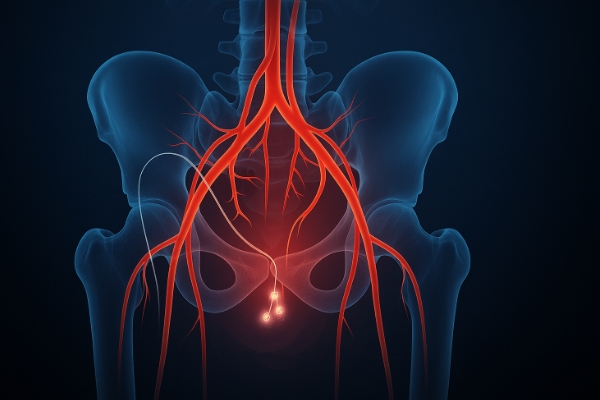
Hemorrhoidal artery embolization, or HAE, is a catheter-based treatment used mainly for selected patients whose internal hemorrhoids cause repeated bleeding. It reduces blood flow to the hemorrhoidal tissue without surgically removing it. Rectal bleeding should never be assumed to come from hemorrhoids. A proper examination—and colon evaluation when appropriate—must come first.
Internal and external hemorrhoids are different
Internal hemorrhoids form inside the anal canal and often cause painless, bright-red bleeding or tissue that protrudes during a bowel movement. External hemorrhoids form under the skin outside the anus and may cause a tender lump, irritation, or pain. HAE targets the arterial supply to internal hemorrhoids. It does not remove external hemorrhoids and should not be presented as a treatment for external disease.
Why bleeding needs a diagnosis
Hemorrhoids are a common cause of rectal bleeding, but bleeding can also result from a fissure, inflammation, polyps, diverticular disease, abnormal blood vessels, or colorectal cancer. The evaluation depends on age, symptoms, anemia, family history, prior screening, examination, and other risk factors.
Who may be considered?
HAE may be discussed after internal hemorrhoids have been confirmed. A gastroenterologist or colorectal specialist may be involved when colon evaluation is needed, and surgical options are best reviewed with a colorectal surgeon. Recurrent bleeding is the best-established reason to consider embolization. A large external component, active infection, another source of bleeding, or symptoms better treated mechanically may point to a different treatment. Prolapse is not an automatic contraindication. Published experience suggests that selected patients with grade II or III prolapse may be considered when bleeding is the main symptom. Grade IV prolapse is generally treated surgically; HAE may be considered only in selected patients who cannot undergo surgery.
The outpatient procedure and recovery
An interventional radiologist guides a small catheter through an artery to the vessels that supply the rectum. Angiography maps the branches. Small coils, particles, or another embolic material may be used to reduce blood flow to the internal hemorrhoidal tissue while protecting nearby circulation. Provectus performs HAE as an outpatient procedure, generally with local anesthesia and moderate sedation when clinically appropriate. Patients go home after monitored recovery. Bruising at the access site and mild pelvic or rectal discomfort may occur. Instructions cover activity, medications, bowel habits, and signs that need prompt evaluation.
Benefits, limits, and risks
HAE avoids cutting or removing anorectal tissue. This generally means less post-treatment pain and no surgical wound in that area.
The evidence base is smaller than it is for established office and surgical treatments. Prolapse tends to improve less reliably than bleeding, and symptoms can persist or return. Having HAE does not prevent later banding, another embolization session, or surgery if needed. Possible complications include bleeding or injury at the access site, contrast reaction, kidney injury, infection, unintended embolization, ulceration, or tissue injury from reduced blood flow. Individual risks are reviewed before treatment.
Comparing treatment options
Options may include fiber, hydration, changes in bowel habits, topical symptom relief, rubber-band ligation, sclerotherapy, infrared coagulation, surgical ligation, or hemorrhoidectomy. The right choice depends on whether bleeding, prolapse, pain, an external component, or another diagnosis is driving the symptoms.
When bleeding is urgent
Heavy or ongoing bleeding with fainting, marked weakness, chest pain, or shortness of breath can be an emergency; call 911. Black stool or severe abdominal pain also needs urgent evaluation.
Patient Q&A
Is HAE only for bleeding hemorrhoids?
Bleeding from confirmed internal hemorrhoids is the main symptom HAE is designed to treat. Some patients may also have prolapse or discomfort, but those symptoms may respond less predictably.
Does HAE treat external hemorrhoids?
No. HAE does not remove external hemorrhoidal tissue.
Do I need a colorectal evaluation first?
The source of bleeding must be confirmed. A gastroenterologist may perform needed colon evaluation, while a colorectal surgeon can assess prolapse and compare office-based or surgical treatments with HAE.
Can HAE replace surgery for severe prolapse?
Usually not. Grade II or III prolapse does not automatically exclude HAE when bleeding is the main problem, but grade IV prolapse usually needs surgery. HAE may still be discussed when surgery is not possible because of the patient’s health.
Can hemorrhoids return after HAE?
Yes. Bleeding may persist or return, and some patients later need another treatment.